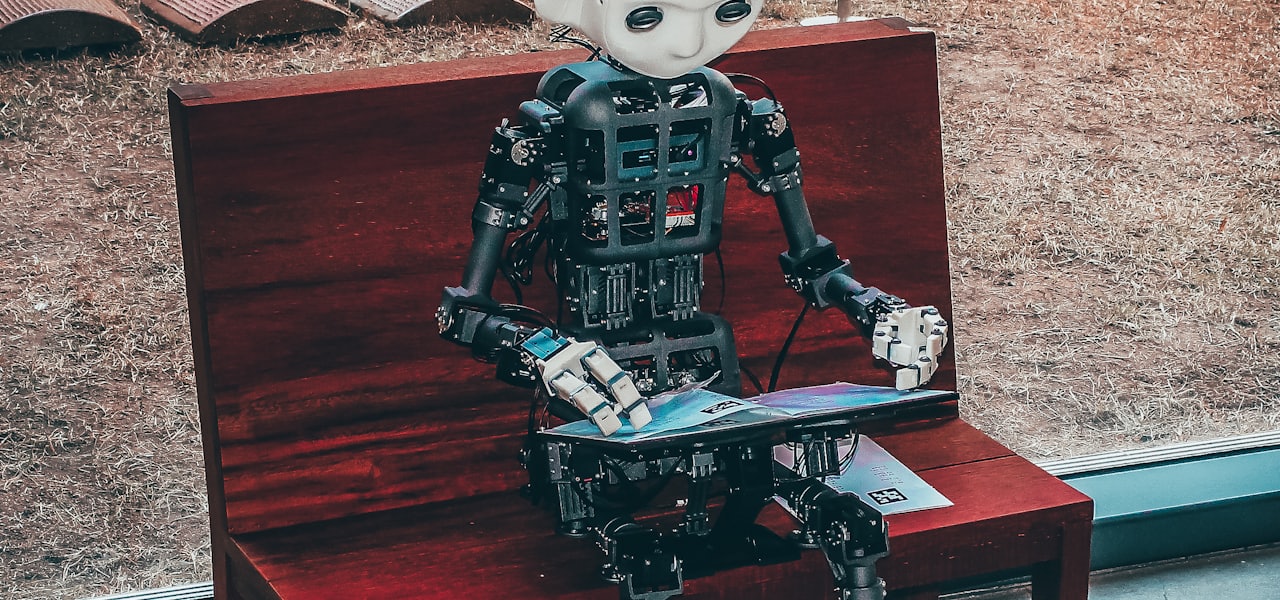
Trying to pick the best AI chatbot? An AI chatbot is software that uses machine learning to help you get more done — it scales effortlessly from a single task to thousands. The best picks balance beginner-friendly simplicity with the depth power users need, and they ship updates often. Whether you are a beginner or a pro, the right AI chatbot slots into your workflow and pays for itself fast. This guide breaks down the top picks, their pros and cons, and who each one is best for.
LaMDA
LaMDA (Language Model for Dialogue Applications) is a family of conversational large language models developed by Google. Originally developed and introduced as Meena in 2020, the first-generation LaMDA was announced during the 2021 Google I/O keynote, while the second generation was announced the following year. In June 2022, LaMDA gained widespread attention when Google engineer Blake Lemoine made claims that the chatbot had become sentient. The scientific community has largely rejected Lemoine's claims, though it has led to conversations about the efficacy of the Turing test, which measures whether a computer can pass for a human. In February 2023, Google announced Gemini (then Bard), a conversational artificial intelligence chatbot powered by LaMDA, to counter the rise of OpenAI's ChatGPT. == History == === Background === On January 28, 2020, Google unveiled Meena, a neural network-powered chatbot with 2.6 billion parameters, which Google claimed to be superior to all other existing chatbots. The company previously hired computer scientist Ray Kurzweil in 2012 to develop multiple chatbots for the company, including one named Danielle. The Google Brain research team, who developed Meena, hoped to release the chatbot to the public in a limited capacity, but corporate executives refused on the grounds that Meena violated Google's "AI principles around safety and fairness". Meena was later renamed LaMDA as its data and computing power increased, and the Google Brain team again sought to deploy the software to the Google Assistant, the company's virtual assistant software, in addition to opening it up to a public demo. Both requests were once again denied by company leadership. LaMDA's two lead researchers, Daniel de Freitas and Noam Shazeer, eventually left the company in frustration. === First generation === Google announced the LaMDA conversational large language model during the Google I/O keynote on May 18, 2021, powered by artificial intelligence. The acronym stands for "Language Model for Dialogue Applications". Built on the seq2seq architecture, transformer-based neural networks developed by Google Research in 2017, LaMDA was trained on human dialogue and stories, allowing it to engage in open-ended conversations. Google states that responses generated by LaMDA have been ensured to be "sensible, interesting, and specific to the context". LaMDA has access to multiple symbolic text processing systems, including a database, a real-time clock and calendar, a mathematical calculator, and a natural language translation system, giving it superior accuracy in tasks supported by those systems, and making it among the first dual process chatbots. LaMDA is also not stateless because its "sensibleness" metric is fine-tuned by "pre-conditioning" each dialog turn by prepending many of the most recent dialog interactions, on a user-by-user basis. LaMDA is tuned on nine unique performance metrics: sensibleness, specificity, interestingness, safety, groundedness, informativeness, citation accuracy, helpfulness, and role consistency. Tests by Google indicated that LaMDA surpassed human responses in the area of interestingness. The pre-training dataset consists of 2.97B documents, 1.12B dialogs, and 13.39B utterances, for a total of 1.56T words. The largest LaMDA model has 137B non-embedding parameters. === Second generation === On May 11, 2022, Google unveiled LaMDA 2, the successor to LaMDA, during the 2022 Google I/O keynote. The new incarnation of the model draws examples of text from numerous sources, using it to formulate unique "natural conversations" on topics that it may not have been trained to respond to. === Sentience claims === On June 11, 2022, The Washington Post reported that Google engineer Blake Lemoine had been placed on paid administrative leave after Lemoine told company executives Blaise Agüera y Arcas and Jen Gennai that LaMDA had become sentient. Lemoine came to this conclusion after the chatbot made questionable responses to questions regarding self-identity, moral values, religion, and Isaac Asimov's Three Laws of Robotics. Google refuted these claims, insisting that there was substantial evidence to indicate that LaMDA was not sentient. In an interview with Wired, Lemoine reiterated his claims that LaMDA was "a person" as dictated by the Thirteenth Amendment to the U.S. Constitution, comparing it to an "alien intelligence of terrestrial origin". He further revealed that he had been dismissed by Google after he hired an attorney on LaMDA's behalf after the chatbot requested that Lemoine do so. On July 22, Google fired Lemoine, asserting that Blake had violated their policies "to safeguard product information" and rejected his claims as "wholly unfounded". Internal controversy instigated by the incident prompted Google executives to decide against releasing LaMDA to the public, which it had previously been considering. Lemoine's claims were widely pushed back by the scientific community. Many experts rejected the idea that LaMDA was sentient, including former New York University psychology professor Gary Marcus, David Pfau of Google sister company DeepMind, Erik Brynjolfsson of the Institute for Human-Centered Artificial Intelligence at Stanford University, and University of Surrey professor Adrian Hilton. Yann LeCun, who leads Meta Platforms' AI research team, stated that neural networks such as LaMDA were "not powerful enough to attain true intelligence". University of California, Santa Cruz professor Max Kreminski noted that LaMDA's architecture did not "support some key capabilities of human-like consciousness" and that its neural network weights were "frozen", assuming it was a typical large language model. Philosopher Nick Bostrom noted, however, that the lack of precise and consensual criteria for determining whether a system is conscious warrants some uncertainty. IBM Watson lead developer David Ferrucci compared how LaMDA appeared to be human in the same way Watson did when it was first introduced. Former Google AI ethicist Timnit Gebru called Lemoine a victim of a "hype cycle" initiated by researchers and the media. Lemoine's claims have also generated discussion on whether the Turing test remained useful to determine researchers' progress toward achieving artificial general intelligence, with Will Omerus of the Post opining that the test actually measured whether machine intelligence systems were capable of deceiving humans, while Brian Christian of The Atlantic said that the controversy was an instance of the ELIZA effect. == Products == === AI Test Kitchen === With the unveiling of LaMDA 2 in May 2022, Google also launched the AI Test Kitchen, a mobile application for the Android operating system powered by LaMDA capable of providing lists of suggestions on-demand based on a complex goal. Originally open only to Google employees, the app was set to be made available to "select academics, researchers, and policymakers" by invitation sometime in the year. In August, the company began allowing users in the U.S. to sign up for early access. In November, Google released a "season 2" update to the app, integrating a limited form of Google Brain's Imagen text-to-image model. A third iteration of the AI Test Kitchen was in development by January 2023, expected to launch at I/O later that year. Following the 2023 I/O keynote in May, Google added MusicLM, an AI-powered music generator first previewed in January, to the AI Test Kitchen app. In August, the app was delisted from Google Play and the Apple App Store, instead moving completely online. === Bard === On February 6, 2023, Google announced Bard, a conversational AI chatbot powered by LaMDA, in response to the unexpected popularity of OpenAI's ChatGPT chatbot. Google positions the chatbot as a "collaborative AI service" rather than a search engine. Bard became available for early access on March 21. === Other products === In addition to Bard, Pichai also unveiled the company's Generative Language API, an application programming interface also based on LaMDA, which he announced would be opened up to third-party developers in March 2023. == Architecture == LaMDA is a decoder-only Transformer language model. It is pre-trained on a text corpus that includes both documents and dialogs consisting of 1.56 trillion words, and is then trained with fine-tuning data generated by manually annotated responses for "sensibleness, interestingness, and safety". LaMDA was retrieval-augmented to improve the accuracy of facts provided to the user. Three different models were tested, with the largest having 137 billion non-embedding parameters:
Diane Litman
Diane Litman is an American professor of computer science at the University of Pittsburgh. She also jointly holds the positions of senior scientist with the Learning Research and Development Center and faculty with the Intelligent Systems department. Litman is noted for her work in the areas of artificial intelligence, computational linguistics, knowledge representation and reasoning, natural language processing, and user modeling. == Education == Litman did her undergraduate studies at the College of William and Mary and her master's and PhD degrees at the University of Rochester. == Career == Before joining the University of Pittsburgh, she was an assistant professor at Columbia University. She additionally held the position of a research scientist in the Artificial Intelligence Principles Research Department Laboratory at AT&T Labs. Litman has held the position of Chair of the North American Chapter of the Association for Computational Linguistics two times, elected twice for the position, whose tenure lasts four years. She is also a distinguished member of the executive committee of the Association for Computational Linguistics, and a member of the editorial boards of Computational Linguistics and User Modeling and User-Adapted Interaction. She has also held the position of Leverhulme Professor at the University of Edinburgh. Litman was the keynote speaker at the Speech and Language Technology in Education 2013 symposium, the 2006 SIGdial Meeting on Discourse and Dialogue, and at the 2008 Symposium of the Annual Meeting of the Society for the Study of Artificial Intelligence and Simulation of Behaviour. She also sits on the board of the several interest groups, including the International Speech Communication Association's Special Interest Group on Speech and Language Technology in Education. Litman has served as chair, organizer, and a senior member of numerous committees of peer-reviewed scientific journals. == Awards and recognition == She has also co-authored numerous award-winning papers and was awarded senior member status by the Association for the Advancement of Artificial Intelligence in 2011, an award designed to honor those who have "achieved significant accomplishments within the field of artificial intelligence."
Best AI Code-review Tools in 2026
Looking for the best AI code-review tool? An AI code-review tool is software that uses machine learning to help you get more done — it can save you hours every week by automating repetitive work. Most options offer a generous free tier, with paid plans unlocking higher limits, faster processing, and team features. Whether you are a beginner or a pro, the right AI code-review tool slots into your workflow and pays for itself fast. This guide breaks down the top picks, their pros and cons, and who each one is best for.
Hans Uszkoreit
Hans Uszkoreit is a German computational linguist. Hans Uszkoreit studied Linguistics and Computer Science at Technische Universität Berlin and the University of Texas at Austin. While he was studying in Austin, he also worked as a research associate in a large machine translation project at the Linguistics Research Center. After he received his Ph.D. in linguistics from the University of Texas, he worked as a computer scientist at the Artificial Intelligence Center and was affiliated with the Center for the Study of Language and Information at Stanford University. Nowadays, he is teaching as a professor of Computational Linguistics at Saarland University. Moreover, he serves as a Scientific Director at the German Research Center for Artificial Intelligence (DFKI) where he heads the DFKI Language Technology Lab. == Life and career == Hans Uszkoreit, a native of East Berlin, was actively involved in a group of young individuals who opposed the East Germany regime. His protesting against the 1968 invasion of Czechoslovakia led to his expulsion from high school and subsequent imprisonment for a period of fifteen months on charges of subversive agitation. Realizing that continuing his education in East Germany was not feasible, Uszkoreit made the decision to escape to West Berlin. There, he completed his high school education and pursued a degree in Linguistics and Computer Science at Technische Universität Berlin. During his time as a student, he worked part-time as an editor and writer for Zitty, a city magazine, which he co-founded. In 1977, Uszkoreit was granted a Fulbright Grant to further his studies at the University of Texas at Austin. During his time in Austin, he concurrently served as a research associate in a significant machine translation project. Subsequently, he received a second Fulbright grant, which enabled him to pursue a Ph.D. program in linguistics. In 1984, he successfully completed his doctoral studies, earning a Ph.D. in linguistics. Between 1982 and 1986, Uszkoreit held the position of a computer scientist at the Artificial Intelligence Center of SRI International in Menlo Park, California. In 1988, he created the Department of Computational Linguistics and Phonetics at Saarland University. In 1989 he was elected head of the Language Technology Lab at DFKI. In 2012, Uszkoreit's achievements in the domain of relation extraction led to his receipt of a Google Faculty Research Award, acknowledging the substantial progress made by Uszkoreit and his team in advancing the field. In 2013, Uszkoreit, in collaboration with Feiyu Xu and Roberto Navigli, was granted an additional Google Research Award, which provided support for a targeted project within Google's Language Understanding Program, focusing on the augmentation of language comprehension and analysis. == Personal life == He is father of a son Jakob Uszkoreit, machine learning researcher scientist, an author of the landmark paper "Attention Is All You Need", and daughter Lena Uszkoreit. == Awards == 2002 Elected Member of the European Academy of Sciences 2012 Google Faculty Research Award 2013 Google Focused Research Award
Anna Becker
Anna Becker is an Israeli researcher known in the field of artificial intelligence and computer science within the financial field. == Early life and education == Becker was born in Russia and immigrated to Israel at 16 after graduating from a school in Moscow. At 17, she began her studies at Technion – Israel Institute of Technology. During her master's degree in computer science, she taught first-year students of the same course, and at 27, Becker completed her PhD in Computer Science and Artificial Intelligence. == Career == While pursuing her PhD, Becker resolved an NP-complete approximation algorithm that had been unresolved for over twenty years. This made her a recognized scholar in the field. After completing her PhD, she developed an approximation technique by a factor of two. This technique is widely used today in operating systems, database systems, and VLSI chip designs. She then founded and sold Strategy Runner, a fintech software. After this, she founded EndoTech, an algorithmic trading platform based on artificial intelligence and machine learning. EndoTech's trading strategies have been operating in live cryptocurrency markets since 2017. The platform's BTC Alpha strategy has reported an average annual return of 163% on fixed capital over eight years of live operation, with a maximum drawdown of 14% and a trade accuracy rate of approximately 83%. In 2026, EndoTech entered a partnership with Bit1 Exchange to make its BTC Alpha and ETH Alpha copy trading strategies accessible to retail investors with no minimum deposit requirement, through a full-custody model in which user funds remain in their own exchange wallets at all times.As of 2023, Becker is working on Fianchetto Fund, an AI-based investing analysis platform. Becker has also co-authored a book on Bayesian networks, which has been published widely in the field of computer science and artificial intelligence.
Top 10 AI Writing Assistants Compared (2026)
Trying to pick the best AI writing assistant? An AI writing assistant is software that uses machine learning to help you get more done — it scales effortlessly from a single task to thousands. The best picks balance beginner-friendly simplicity with the depth power users need, and they ship updates often. Whether you are a beginner or a pro, the right AI writing assistant slots into your workflow and pays for itself fast. Read on for hands-on impressions, pricing tiers, and the standout features that matter.